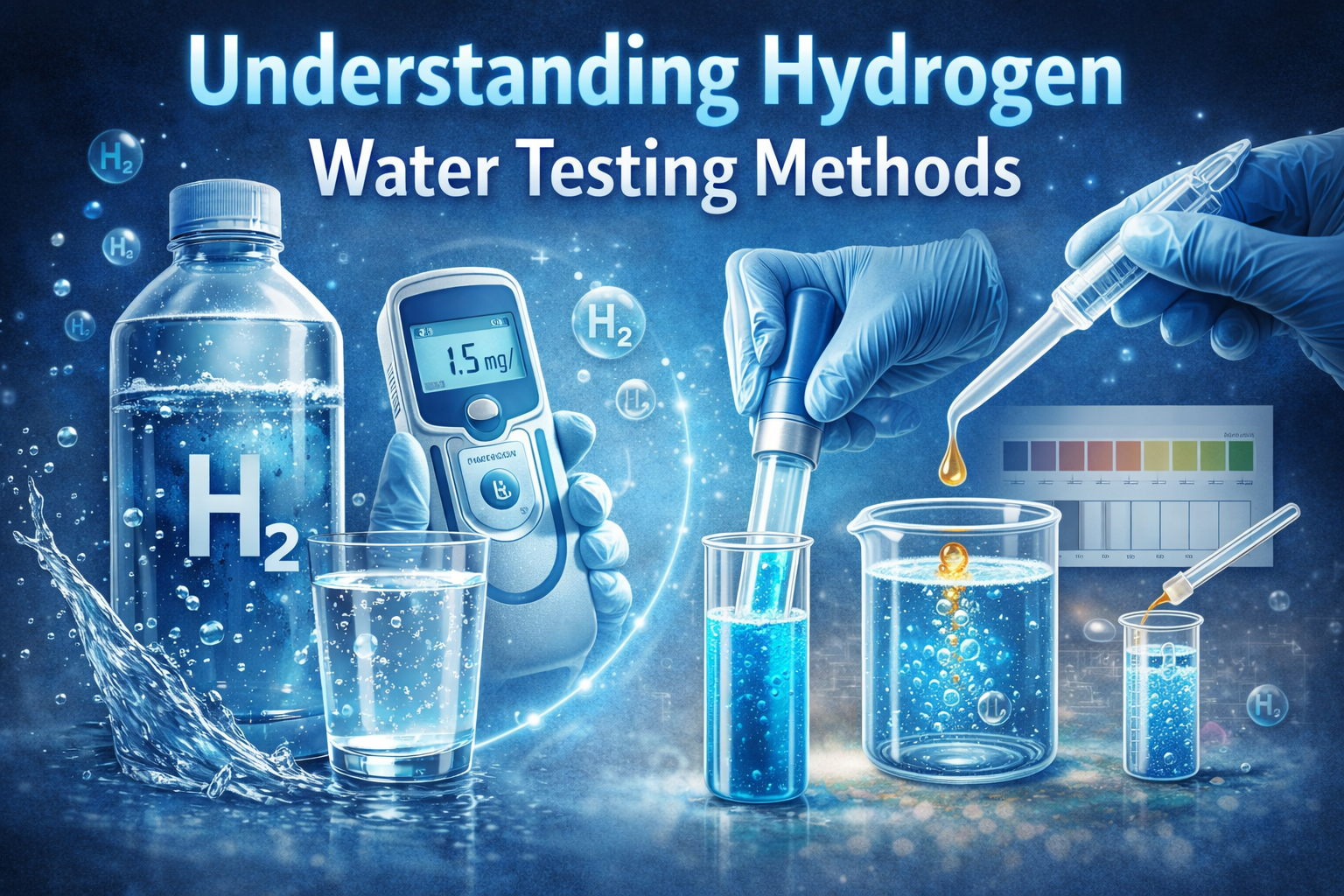
Introduction
Molecular hydrogen (H₂) research continues to expand, with increasing interest in hydrogen-rich water as a potential tool for supporting redox balance and cellular health.
However, one critical and often overlooked aspect is how hydrogen is measured.
In this month’s highlight, we review key insights from a recent educational breakdown on hydrogen water testing methods, focusing on the accuracy and limitations of commonly used tools.
Why Measurement Matters
Hydrogen is a unique molecule:
- It is colorless, odorless, and tasteless
- It diffuses rapidly and can easily escape from water
Because of this, accurate measurement is essential. Without it, it becomes difficult to:
- Verify hydrogen concentration
- Compare products
- Interpret research or real-world use
Key Insight
A central takeaway is:
Not all hydrogen testing methods measure hydrogen gas directly.
Different tools measure different properties, and misunderstanding this distinction can lead to incorrect conclusions.
Overview of Common Testing Methods
ORP (Oxidation-Reduction Potential) Meters
ORP meters are widely used due to their convenience.
However, they measure:
- The overall redox potential of a solution
They do not measure hydrogen concentration.
ORP readings can be influenced by:
- pH
- Dissolved minerals
- Other redox-active compounds
Interpretation:
ORP may reflect general redox activity but should not be used to quantify hydrogen levels.
Reagent-Based Tests (Colorimetric Methods)
Reagent-based tests provide a more direct approach to estimating hydrogen.
One example is the H2 Blue Hydrogen Test Reagent.
These tests:
- Use a chemical reaction with dissolved hydrogen
- Produce a color change that correlates with concentration
Strengths:
- Practical and accessible
- More directly related to hydrogen than ORP
Limitations:
- Dependent on proper technique
- Subject to interpretation
- Less precise than laboratory methods
Interpretation:
Useful for approximate measurement, but not definitive quantification.
Gas Chromatography
Gas chromatography is considered the gold standard for hydrogen measurement.
It:
- Directly quantifies hydrogen gas concentration
Strengths:
- High accuracy and reliability
- Used in research settings
Limitations:
- Requires specialized equipment
- Not practical for routine consumer use
Interpretation:
Provides the most accurate measurement available.
Important Consideration: Hydrogen Stability
Hydrogen gas is highly diffusible and can dissipate quickly once water is exposed to air.
This means:
- Timing of measurement is critical
- Delays can lead to underestimation of hydrogen concentration
Why This Matters for the Field
Understanding measurement methods is essential for:
- Researchers designing and interpreting studies
- Clinicians evaluating hydrogen interventions
- Consumers assessing product quality
Without proper measurement, comparisons and conclusions may be unreliable.
Key Takeaways
- Not all testing methods measure hydrogen directly
- ORP meters do not quantify hydrogen concentration
- Reagent-based tests (such as H2 Blue Hydrogen Test Reagent) provide practical but approximate estimates
- Gas chromatography remains the most accurate method
- Measurement timing is critical due to hydrogen’s rapid dissipation
Conclusion
As hydrogen research and applications continue to grow, measurement accuracy remains a foundational issue.
A clear understanding of testing methods helps ensure:
- More reliable data
- Better product evaluation
- Stronger alignment between research and real-world use
Watch the Full Breakdown
For a complete explanation of these testing methods, watch the original video:
🔗 https://youtu.be/3LmF1KdcmAQ
You can view the test report for the reagent here:
🔗https://h2hubb.com/wp-content/uploads/2024/06/H2HUBB-Official-Test-Report-Hydrogen-Test-Reagents-642024-1.2-1.pdf
Explore the MHI Research Database
MHI is building a comprehensive hydrogen research database designed to help clinicians, researchers, and educators easily navigate the scientific literature.
Users will be able to filter studies by:
• condition or disease
• physiological system
• delivery method
• biomarkers
• study type
👉 Explore the Hydrogen Research Database
Want to Learn More?
Members of the MHI Community meet monthly to discuss hydrogen research and ask questions directly with Dr. Tyler LeBaron.